Vintage #9 with Kostaki
Vintage #9 is going to be a double header. Part two will be announced later, but first up we have a winery I’m incredibly excited about: Kostaki Winery.
Located on the Greek island of Samos, the winery was only founded in 2023 by Evmorfia Kostaki and Lorenz Immerfall, but they are already starting to attract serious attention. Their focus is producing serious wines exclusively from Muscat Blanc à Petits Grains, but in a far more contemporary and restrained style than many people associate with the grape.
I was actually planning to do a vintage with them before I’d even decided to make a wine with them, simply because they tick the number one box: being fun people. They’re winemakers who don’t take themselves too seriously, but take the wine very seriously. Their Instagram is full of slightly daft reels that genuinely make me laugh, which is actually how we got chatting in the first place.
I did have my reservations about pinning an entire vintage on white wine (and rosé), which is why I didn’t commit immediately. Then, in a bit of serendipity, another very exciting winery appeared on the horizon that only produces reds and, crucially, harvests after Kostaki. So double the fun this summer!
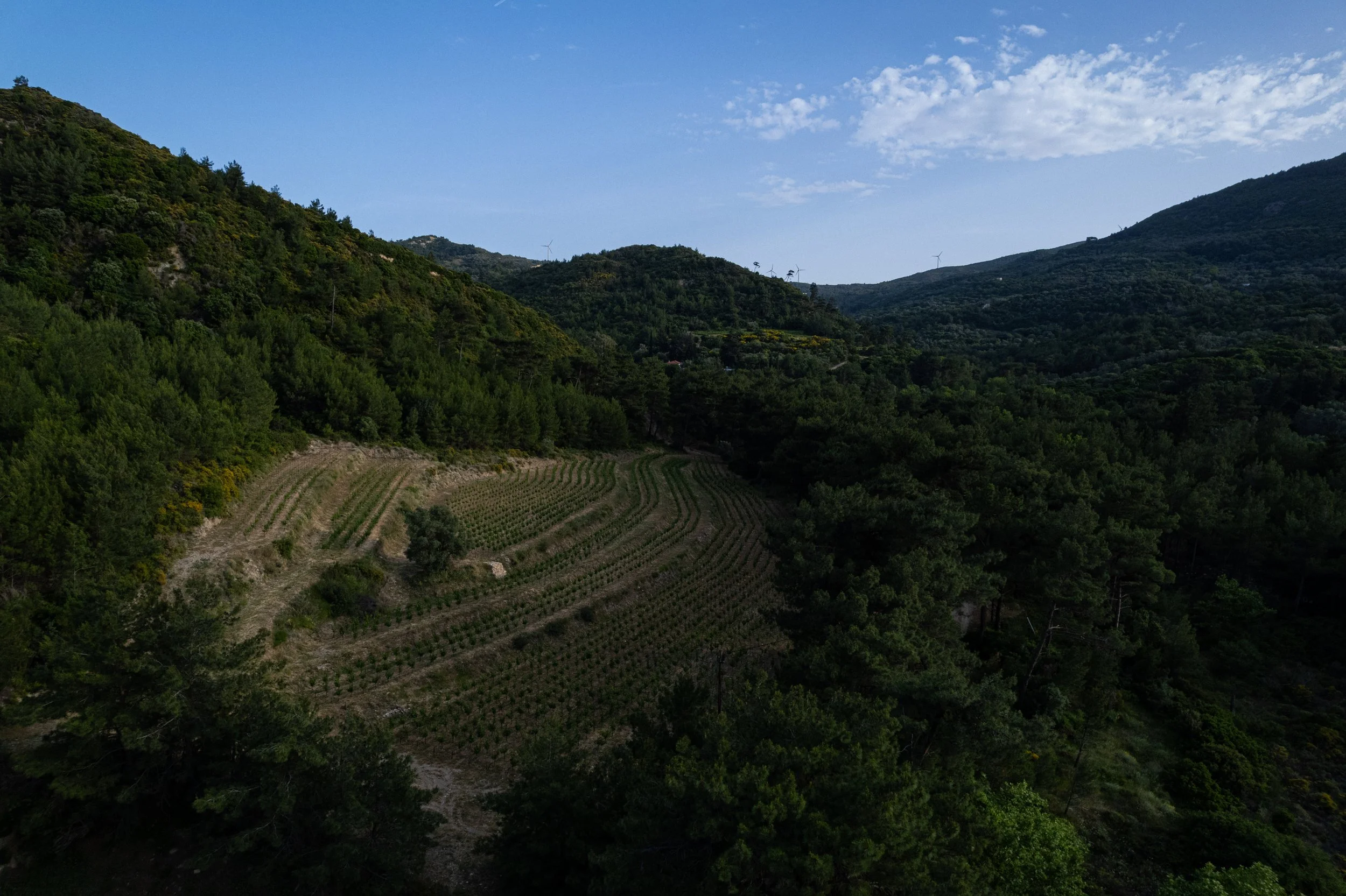
Organic Certified Since 2000
Kostaki have the first certified organic vineyards of Samos. Yiannis Kostakis has been caring for his vineyards over the past 20 years. Listening to the needs of the vines and farming with respect to nature. Inputs are limited, for example, preferring to compost their grape pomace to use as fertiliser rather than buying anything in.
Minimal tilling and natural cover crops are key to the farming. By disturbing the soil as little as possible, they seek to maintain a healthy soil structure and increase organic matter. This increases the soil water holding capacity, allowing the dry-farmed vines to effortlessly ripen the grapes during the dry Mediterranean summer, which seems incredible gien the temperatures we’re expecting during the harvest. The cover crops also naturally dry out in the summer, insulating the soil and reducing its temperature, positively impacting the vineyard microclimate.
All the vineyards are planted with bush vines, and consciously maintained in all our new plantings as well. While bush vines need more hours of care and more experienced care, they provide real benefits in a Greek climate. The canopy is more efficient in photosynthesising, which means fewer leaves are required, reducing the plant’s water needs. In addition, the canopy acts as an umbrella for the vines, protecting them from the sun throughout the day, keeping. The obsession with Muscat starts in the vineyard. It is a difficult variety to farm, because it is susceptible to every vine disease known to humankind. But focusing only on one grape, they are able to listen to its needs and act when it’s necessary to protect the grapes.

Samos
Samos sits just off the coast of modern-day Turkey in the eastern Aegean and has been a crossroads of trade, culture, and agriculture for thousands of years. In antiquity it became one of the great Ionian powers, known for wealth, shipping, engineering, philosophy, and wine. When you add up all those pillars it equates to a lot, squared. It was also the birthplace of Pythagoras and home to the monumental Heraion of Samos.
Wine on Samos stretches back well over two millennia and is deeply woven into both mythology and daily life. Ancient legends linked the island to Dionysus, with stories claiming he taught the Samians how to cultivate vines.
The modern wine industry on Samos was heavily shaped by the formation of the compulsory wine cooperative in 1934: the Union of Winemaking Cooperatives of Samos. This was created partly to protect growers from exploitation by merchants and became central to preserving vineyard culture on the island. The downside is that all production was controlled by the island’s cooperative. For generations, no one outside it could legally produce wine. That began to change only because of one man’s resolve: Evmorfia’s dad. In 2004, he challenged the law that forbade private winemaking. The battle lasted eleven long years of paperwork, persistence, and resistance. Then, in 2015, he won and the door opened for Evmorfia, Lorenz and now Not Yet Named.
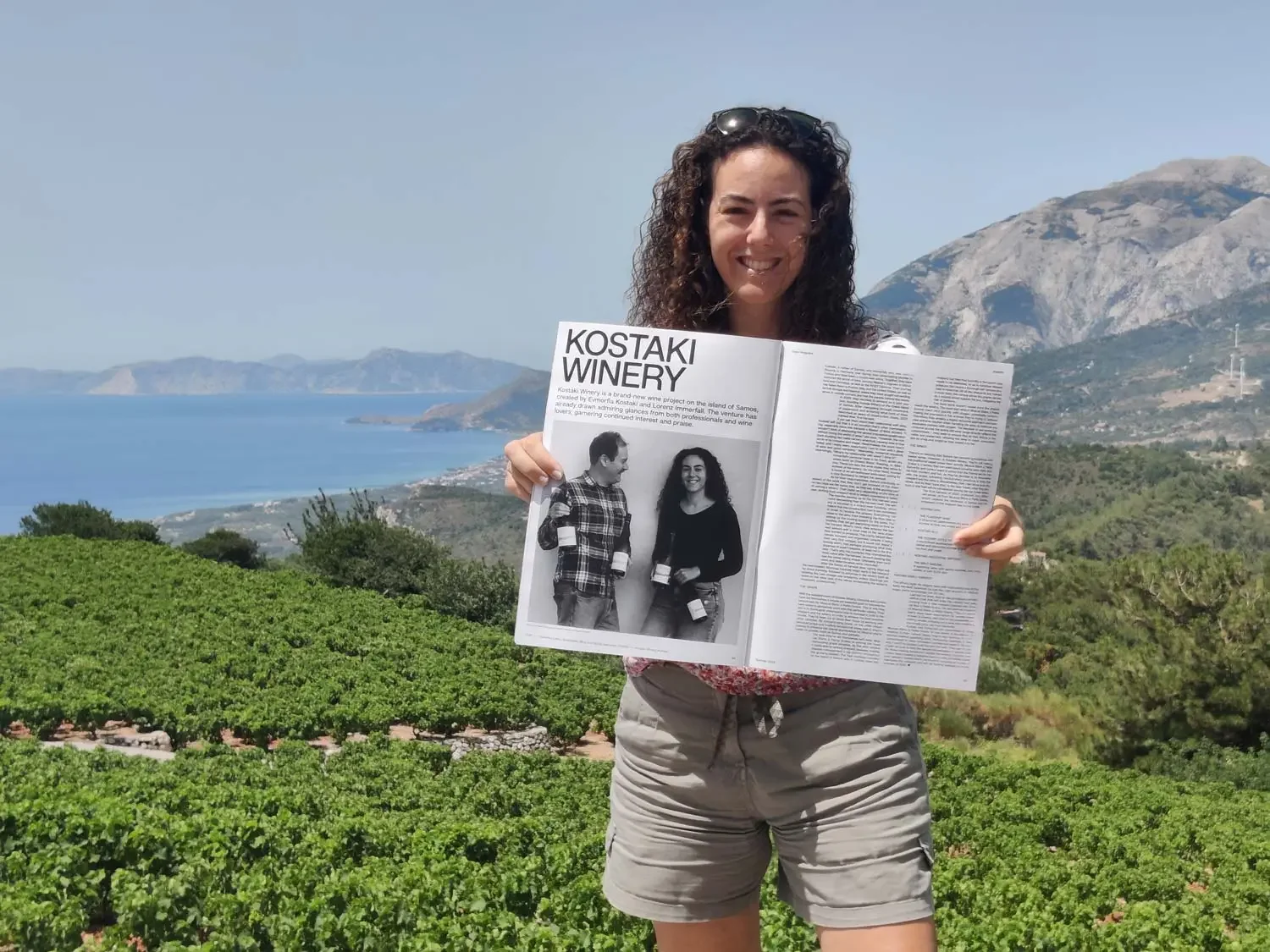
the team
Both seem to be wine nerds academically and practically. They both completed postgraduate studies in viticulture and oenology, alongside WSET Diploma studies, while doing harvests around the world.
Lorenz is a nomad like us, having worked harvests in a ludicrous number of countries: Germany, New Zealand, Australia, France, Austria, Luxembourg, Portugal, Spain, the US, Cyprus and England before landing on Samos.
Evmorfia is also studying toward becoming a Master of Wine with her final exams coming up just before harvest.
Ancient and Modern mythology
The king of Samos and hero of the Argonautic expedition Agaios, is considered the first grape grower of the island.
According to Aristotle, when Agaios returned from the Argonautic expedition to the island, he started viticulture. He forced his slaves to work very hard and one of them cursed him not to drink wine from his first harvest. When the harvest was done and the first wine was prepared from the vines of Agaios, he remembered to mock the slave for his prophecy.
He filled a cup with the first Samian wine and sent other slaves to bring him before him. “You see,” she told him, “your curse didn’t work. Here is the wine, which will clear my throat…” The slave answered with the phrase that has become a proverb: “There is a long way between the cup and the tip of the lip” roughly translating too “Once you’ve made the wine, various wars will make shipping wine a nightmare and completely outside of your control when trying to import the wine.”
Agaios didn’t manage to drink the wine in the end because at that very moment, he was alerted by other slaves to a wild boar destroying his vineyard. He threw away the cup of wine and hurried to the vineyard, where he was killed by the boar, verifying the prophecy.
Plato has since written about similar legends on the Istrian coast of Slovenia, where this time the gods prevailed with the help of modern commerce, purchasing additional Malvazija to create a skinsy number that tastes electric.
Make your own wine Greek Muscat with us!
As always, you’ll help make the wine. Every key decision, from style to structure, will be put to a vote guided by our resident experts. A Muscat-only winery may seem limiting but they have already produced a dry wine, early harvest, ancestral and traditional sparklings, an amber and a rosé wine! There will be votes but also with the chance to go really deep with a varietal.
The only way to join this vintage is by subscribing (commitmnent-phobes are welcome to cancel after the first payment). Part Two will be revealed later this summer but join up to take part in everything we do, bring on July!
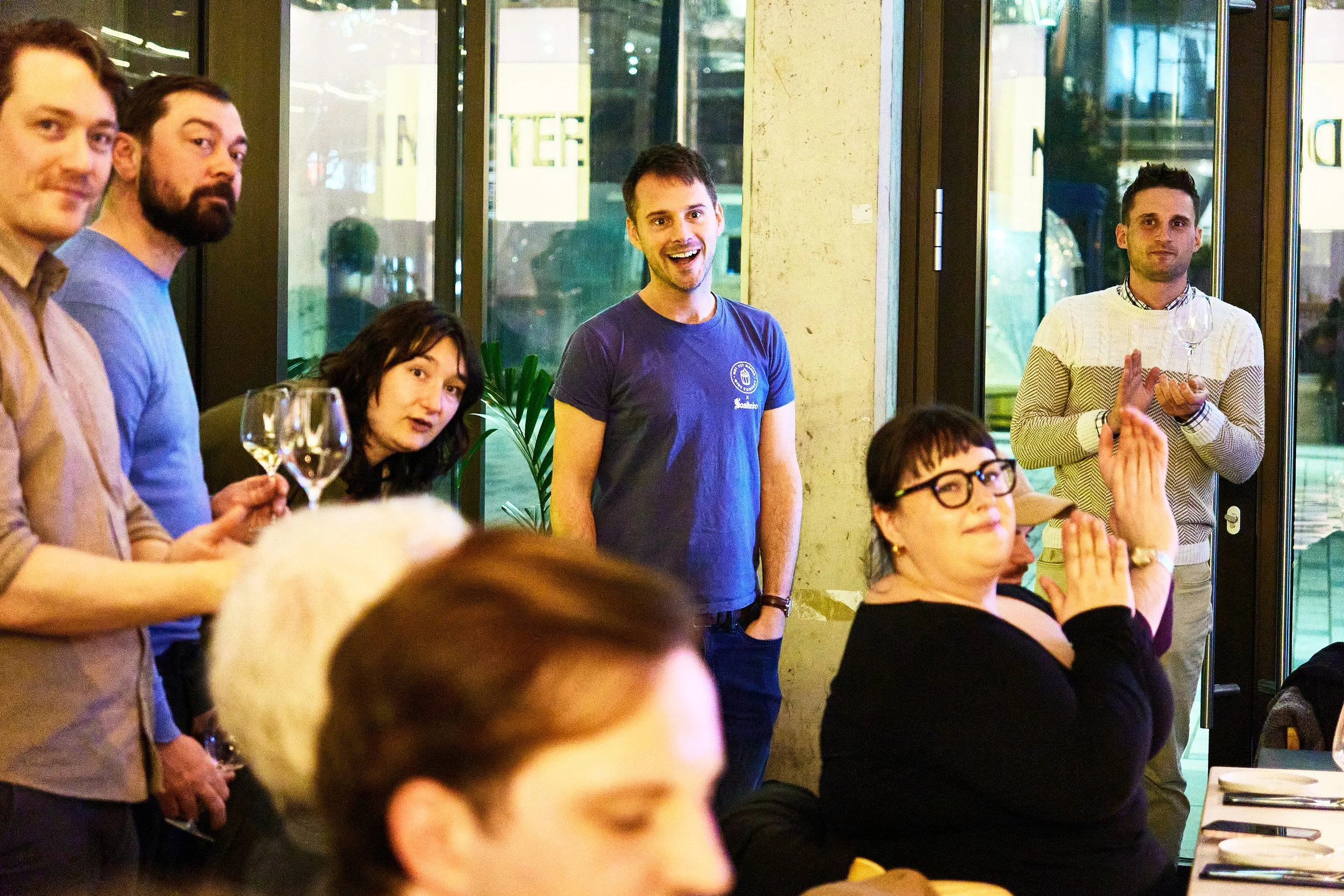
Join Not Yet Named Wine Co. and become part of a wine club where you make the decisions.
You’ll follow each vintage and vote on every winemaking decision as well as the democratically designing a piece of art for the label.
6 BOTTLES NOW!
Receive your first six-bottle case as soon as you join. After that, you can use your credit to order wine whenever you want!
MIX YOUR CASE
Choose from the wines we have made before and build a case to suit you.
EXTRA SUBSCRIBER BENEFITS
Influence the additional wines we make for shops, bars and restaurants
See wines you helped create out in the wild
10% off additional wines, events and merchandise
Invitations to tastings, pick-up parties and school trips
Follow every vintage and track your votes through the app