Pressing Matters
In the quest to make a diamond of a wine, it’s important to squeeze the day and press play, whether that’s on a pneumatic or a basket press. Once a red fermentation is finished (or close to finishing), it’s time to apply a little pressure to get those extra drops, both for quality and for volume, pressure yields results.
What is it?
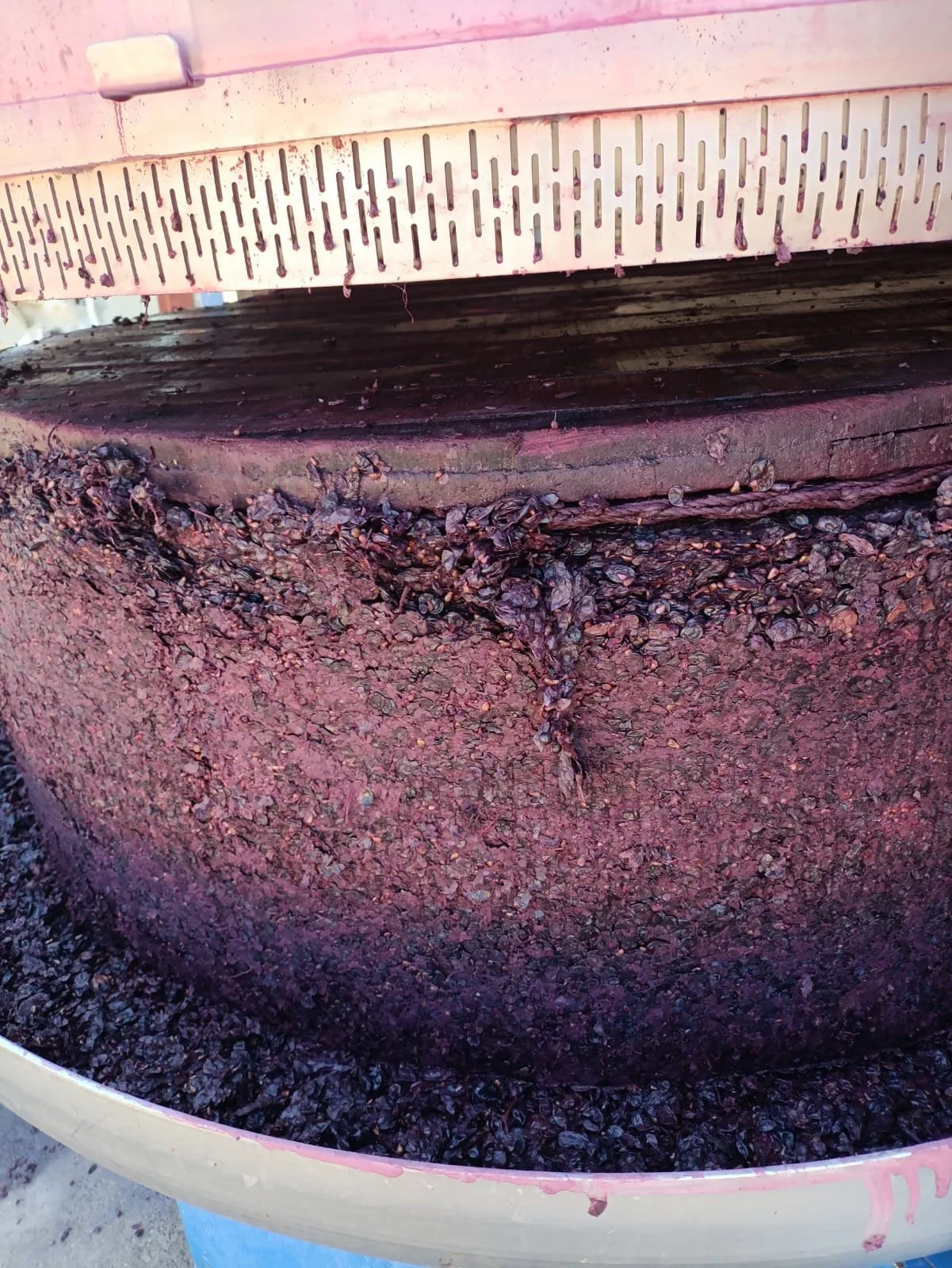
Pressing is the mechanical step where we squeeze whole grapes for whites or fermented skins to separate the liquid from skins and seeds. In red winemaking, it marks the end of skin contact: once you press, extraction of colour and tannin largely stops, and the wine moves from maceration into maturation. It’s mostly about yield, recovering wine trapped in the pomace, but more importantly about selection. Not all press fractions are equal, so pressing is as much about deciding what to keep as it is about getting more wine.
Red and White Pressing
It’s the same operation, just at a different moment. Pressing happens in both white and red winemaking, but at very different points in the process. For whites, it’s a pre-fermentation step: you press to extract juice, then ferment it off skins, with decisions centred on oxidation, phenolics, and clarity.
For reds, pressing is usually post-fermentation (or close to the end). The wine ferments on skins, and pressing is simply separating liquid from solids once you’ve extracted what you want. In that sense, pressing is tightly linked to your maceration choices.
This blog focuses on red pressing, because that’s where our current decision is, but I’ll give this a refresh when we next do a white.
How it works
Pressing reds usually starts by draining the free-run wine by gravity or via pump from the tank. The remaining skins and seeds (a.k.a. the marc or pomace) are then transferred to the press, either pumped across or, for smaller lots like ours, lifted in with a spade.
The key principle is gentle, progressive pressure. You’re aiming to compress the cake slowly, allowing the juice to be liberated little by little. Too much force breaks up skins and seeds, increasing fine solids and extracting harsher tannins.
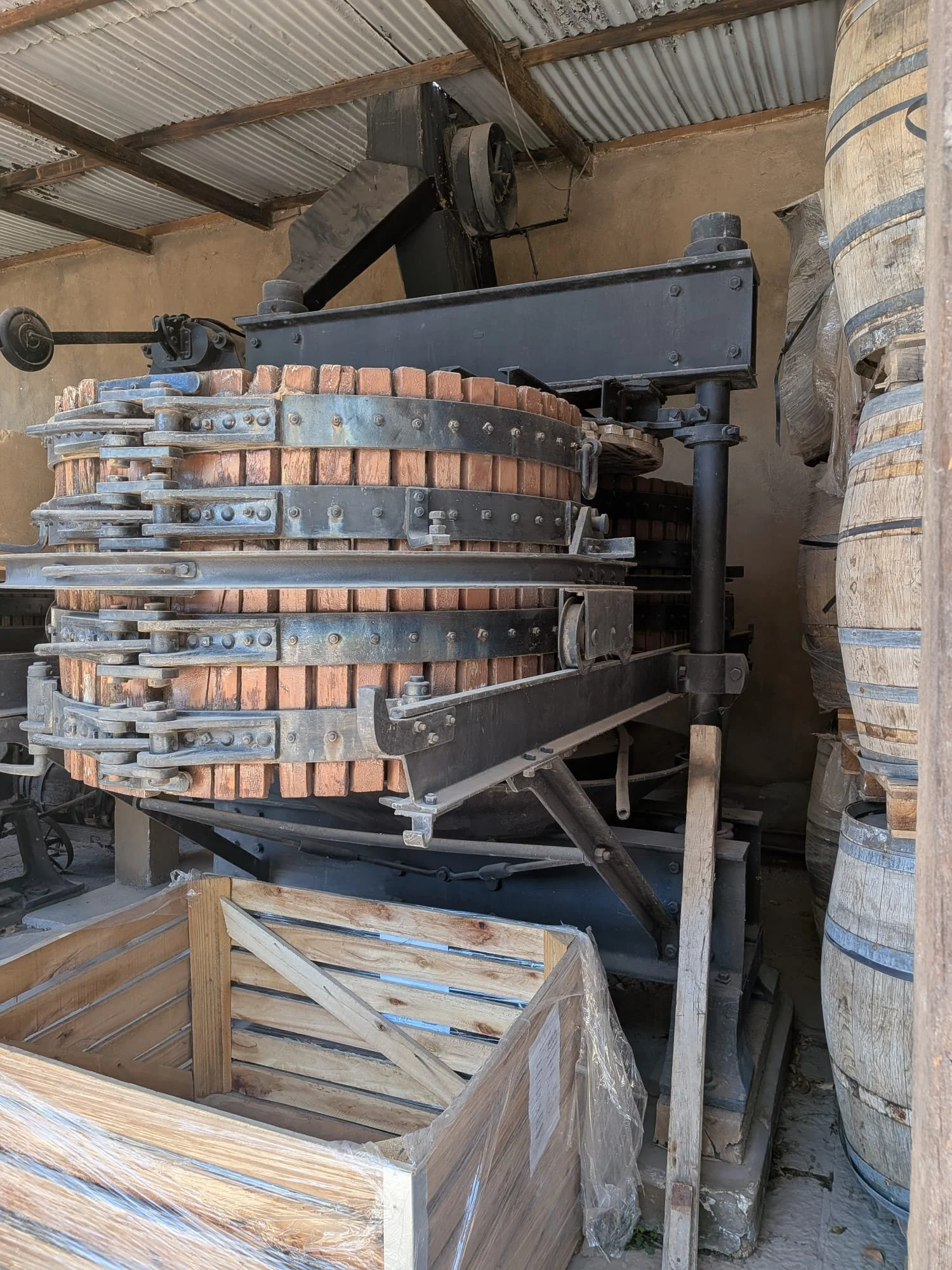
Different presses shape the wine in different ways. Basket presses (vertical presses, as pictured here) are the classic small-lot option: slow, manual, and relatively gentle. They tend to give cleaner, softer press fractions but are labour-intensive. In between press cycles, getting in and breaking it up before pressing again, an action known as crumbling is significantly harder than with a pneumatic press.
Pneumatic presses dominate modern wineries. They use an inflatable membrane to apply controlled pressure in cycles, with those key rotation (“crumble” cycles) to redistribute the solids. They’re efficient, consistent, and can be run under inert gas, helping reduce oxidation. The trade-off is that the crumbling motion, whilst extracting more yield, is a little harsher on the skins.
At the industrial end, continuous screw presses prioritise speed and yield. They’re effective for large volumes but more aggressive, often resulting in higher solids and coarser phenolic extraction, one reason many quality-focused wineries have moved away from them.
The Technical Details - FRee Run vs Pressed Juice
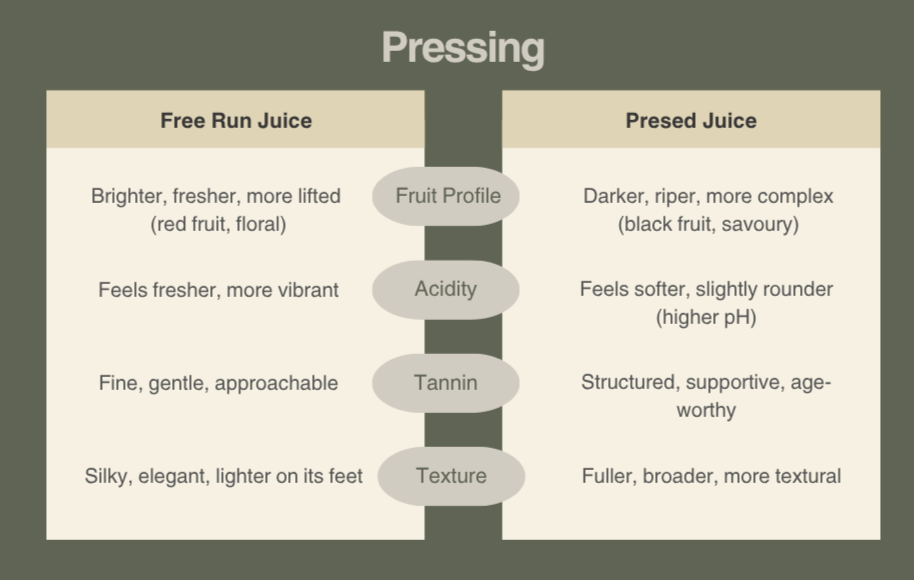
Free-run wine is the fraction that drains naturally by gravity once the door on the tank is opened. Press wine, by contrast, is produced by applying increasing pressure to the fermented pomace, physically forcing liquid out of skins, pulp, and seeds.
Chemically, the differences are consistent. Press fractions tend to have higher concentrations of tannins and flavanols due to increased extraction from skins and especially seeds under pressure. They also typically show higher pH, partly due to increased potassium extraction, which can shift the acid balance in the wrong direction. In contrast, free-run wines often retain higher concentrations of volatile esters, contributing to fresher, more fruit-driven aromatics.
The mechanical action of pressing also increases turbidity, introducing more colloids and solids that can influence mouthfeel but require more settling or clarification. Importantly, extraction during pressing is not linear: early press fractions can resemble free-run quite closely, while later fractions become progressively more phenolic and structured.
For this reason, wineries separate press fractions into multiple cuts. Blending decisions are then made based on sensory evaluation, balancing structure against freshness. We are making too little volume to realistically seperate these fractions though, so it’s all or nothing. Press wine is not inherently inferior, its often preferred. Used judiciously, it builds depth and backbone; overused, it can dominate with bitterness and dryness.
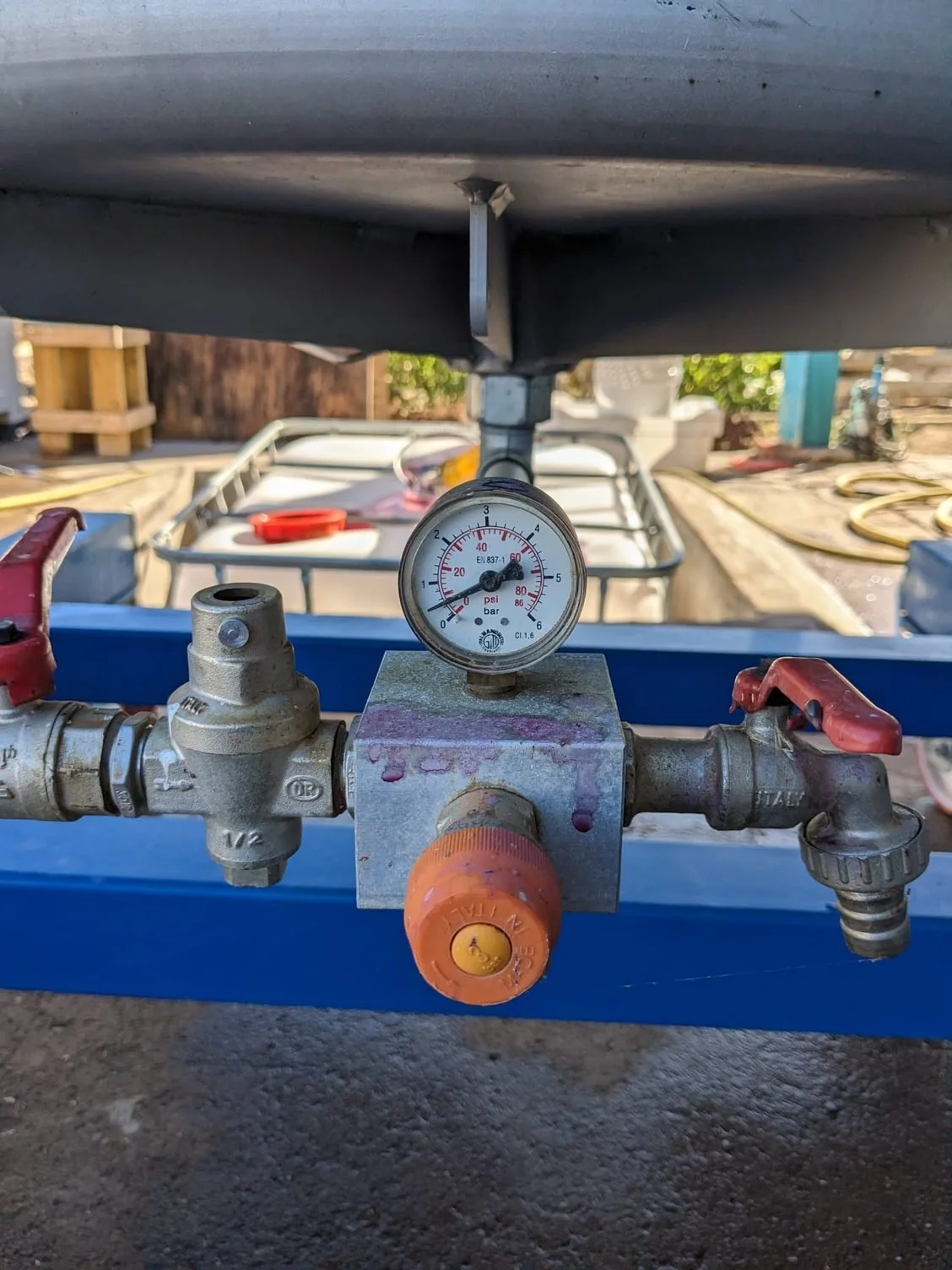
THE PRESSURE
Pressure itself is on of the key variables. You start gently, just enough to release the remaining free liquid, then gradually increase it to extract more from the skins and pulp. As pressure rises, so does what you pull out: more tannin, more colour, more solids. Early press fractions can be surprisingly elegant; later ones can get firmer, drier, sometimes a bit grippy. The art is knowing how far to push it before the wine starts pushing back.
Not Yet NAMED PrESSEs
Our approach has mostly been dictated by volume and whatever equipment was available. Larger pneumatic presses need to be full to build the pressure and be effective, so when working with small lots, we’ve leaned heavily on basket presses, simple, gentle, and ideal for premium, hands-on winemaking.
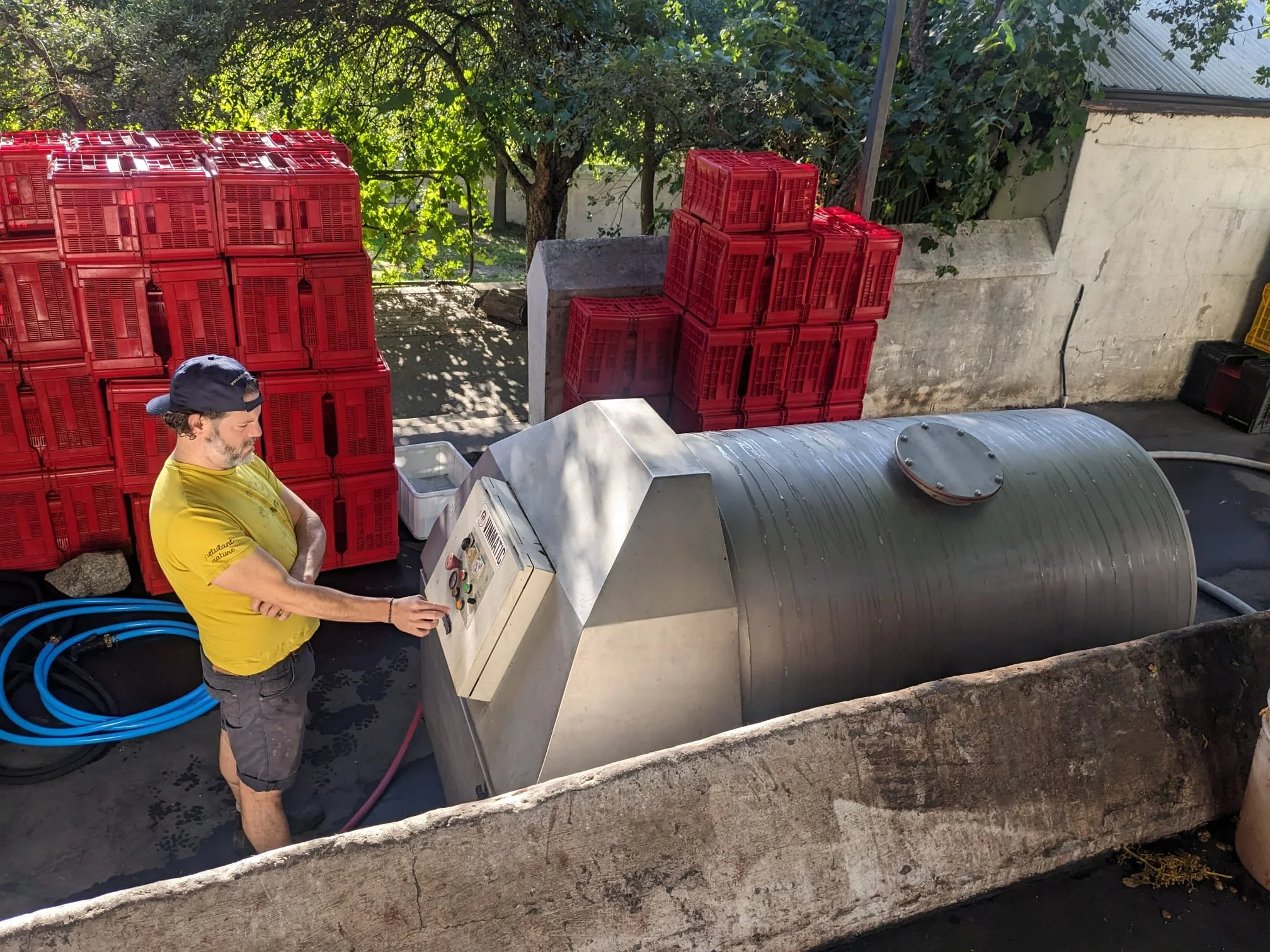
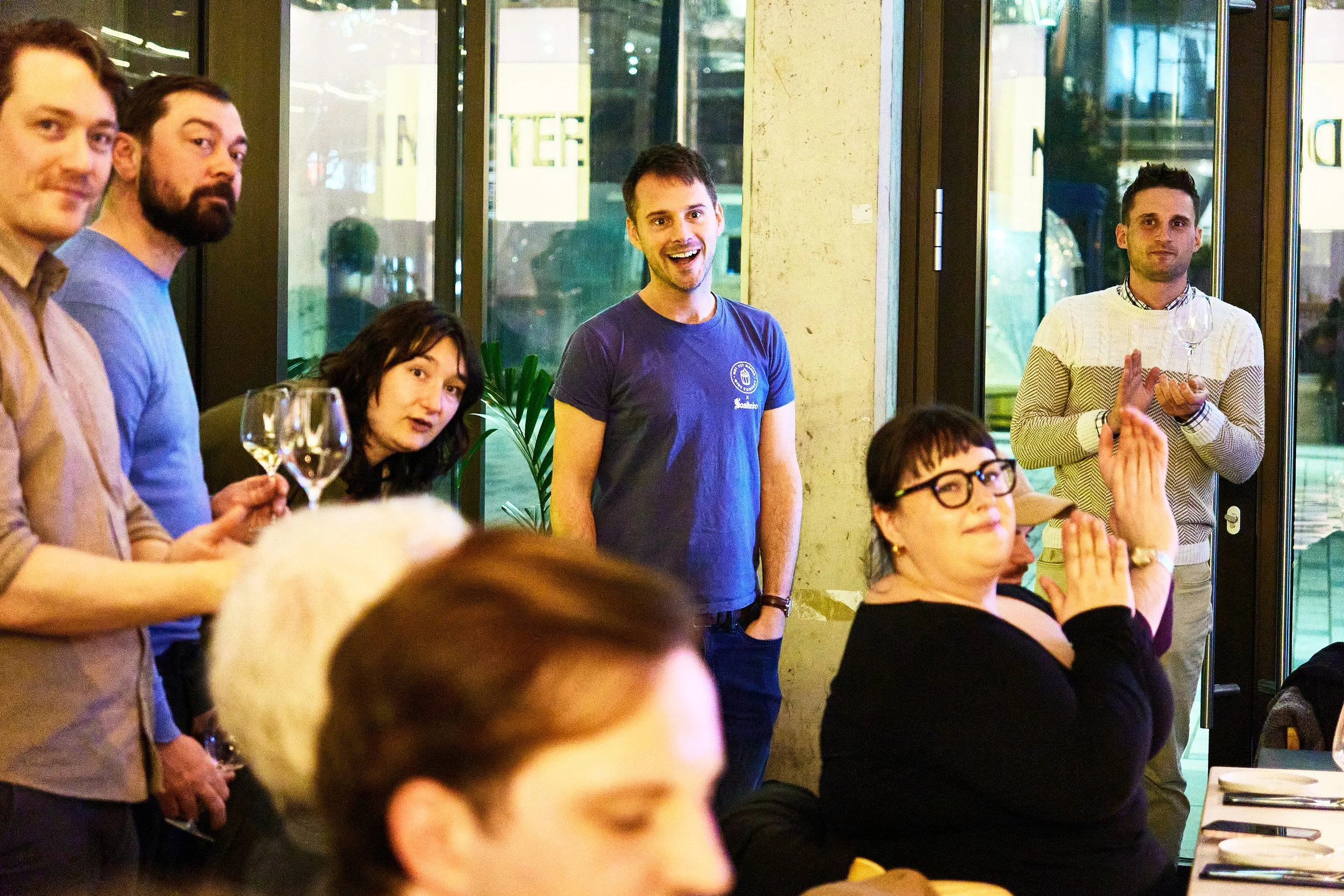
There have been a few exceptions. In the United States, we made much larger volumes and so could use a bigger pneumatic press, but we only bottled what we needed. At Badenhorst in South Africa we had a small, slightly charming pneumatic press (it was a simple easy-to-use machine, pictured above, which makes it difficult to explain José’s confused face). Slovenia was the opposite, a proper relic of a basket press, but it worked beautifully. A reminder that good fundamentals of slow pressure can yield as much as shiny equipment. Australia was pneumatic again, but with a twist—we pressed after a larger load, and left the skins in there to help build pressure more effectively.
Conclusion
Pressing is the moment where extraction stops and timing is everything. Done well, it adds structure, depth, and completeness. Done poorly, and it runs the risk of hardening the wine; raising pH, increasing astringency, and masking fruit. The goal isn’t just to maximise yield, although it helps economics, it’s the final opportunity to dial in structure and tannin before committing the wine to barrel.
Join Not Yet Named Wine Co. and become part of a wine club where you make the decisions.
You’ll follow each vintage and vote on every winemaking decision as well as the democratically designing a piece of art for the label.
6 BOTTLES NOW!
Receive your first six-bottle case as soon as you join. After that, you can use your credit to order wine whenever you want!
MIX YOUR CASE
Choose from the wines we have made before and build a case to suit you.
EXTRA SUBSCRIBER BENEFITS
Influence the additional wines we make for shops, bars and restaurants
See wines you helped create out in the wild
10% off additional wines, events and merchandise
Invitations to tastings, pick-up parties and school trips
Follow every vintage and track your votes through the app