A Fine Choice
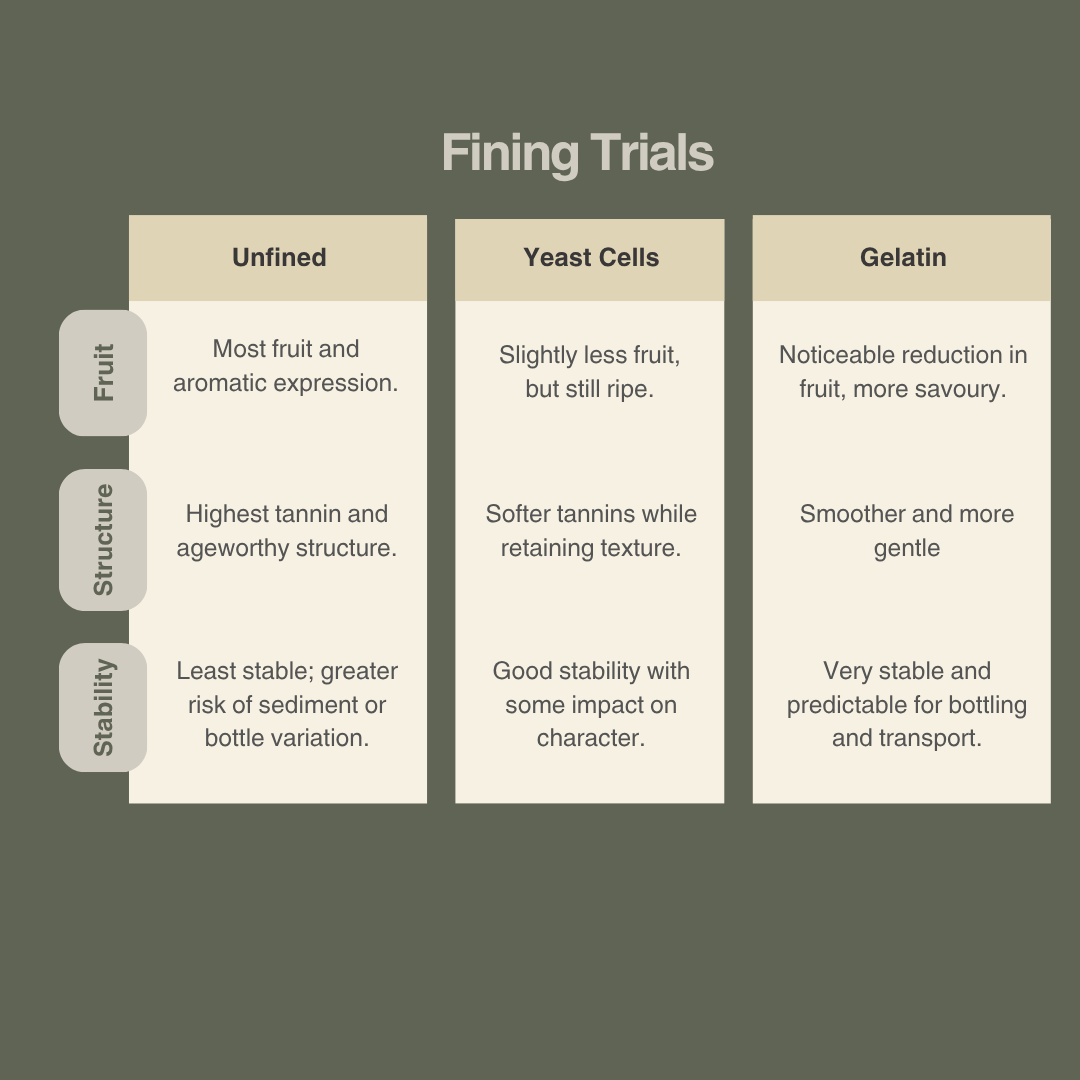
We've recently returned from a school trip to Piedmont to see Gianluca Colombo and he put on a fining trial for us, where we got to try our Langhe Nebbiolo after fining to decide what we wanted to do.
We trialled three versions of the Langhe Nebbiolo:
completely unfined
fined with gelatin
fined with inactive yeast cells
All three were surprisingly different.
Fining is one of those winemaking processes most people never hear about, largely because, when it works well, you’re not really supposed to notice it. But it can have a major impact on texture, bitterness, stability, aromatic clarity, and how a wine behaves over time. First up let’s explain what it is!
What is Fining?
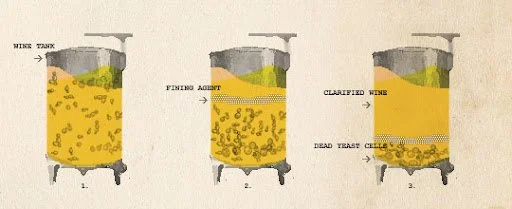
At its simplest, fining is the process of adding a substance to wine that binds to unwanted compounds and drags them out of suspension, like a magnet collecting tiny particles. They then become heavy and settle at the bottom before being removed via racking.
These compounds can include: harsh tannins, unstable proteins, phenolics causing bitterness, excess colour compounds, oxidative elements, and haze-forming particles.
Why do we need to do it?
The biggest reason many wineries fine wines is probably stability.
Wine is constantly changing. Given enough time, many of the particles that cause haze, sediment, bitterness, or instability will naturally settle out by themselves. Historically, this is exactly what happened: wines simply sat in barrel or tank for longer.
The problem is that time is expensive. Tanks are needed for the next harvest, barrels cost money, and wines are often shipped thousands of miles before they're drunk.
For a wine travelling from far away to London, stability becomes particularly important. Temperature fluctuations, vibration, and movement during transport can all expose weaknesses that might never appear in a cellar. It’s less of an issue when travelling from Europe. Fining can accelerate processes that would otherwise happen naturally over months or even years, helping ensure the wine arrives in good condition.
Other Reasons
Texture: A wine can simply feel too aggressive, too bitter, or too drying.
Nebbiolo naturally contains very high levels of tannin so I was keen to try the trial. Fining can soften some of those edges and make the wine more approachable without fundamentally changing its character. In fact in Chile, I used gum arabic to soften my Sangiovese and make it more approachable (I also needed to sell quickly in the early days so I could fund the next vintage). The members rejected this option for S.O.C.K.S. (A Rhone Blend), which I think was the right decision but Sangiovese is a different beast.
Clarity: Some wines are fined because some consumers expect clear wine. Unfined wines can appear hazy or throw sediment. Whilst many wine lovers don't mind this, clarity is still bizarrely often associated with quality.
Aromatic Precision: Certain fining agents can remove heavier phenolics or oxidative compounds, allowing the fruit and floral aromas to appear cleaner and more focused.
Consistency; Commercial wineries need wines to perform consistently from bottle to bottle and market to market. Fining can reduce variation and create a more predictable final product.
Common Fining Agents

Gelatin: One of the classic red wine fining agents. Derived from animal protein, gelatin is very effective at softening harsh tannins and reducing bitterness. One of the rare products that prevent wines from being vegan.
Inactive yeast cells: Essentially dead yeast cell walls. These can bind with reactive compounds while also helping preserve freshness and mouthfeel. They often feel less “stripping” than stronger protein fining agents. Our yeast-cell-fined sample retained more texture and energy than the gelatin version while still tidying up some edges.
Bentonite: A clay-based fining agent mostly used in white wines.Very effective at removing unstable proteins that could otherwise create haze later in bottle. Often used to help clarify wines prior to fermentation as well.
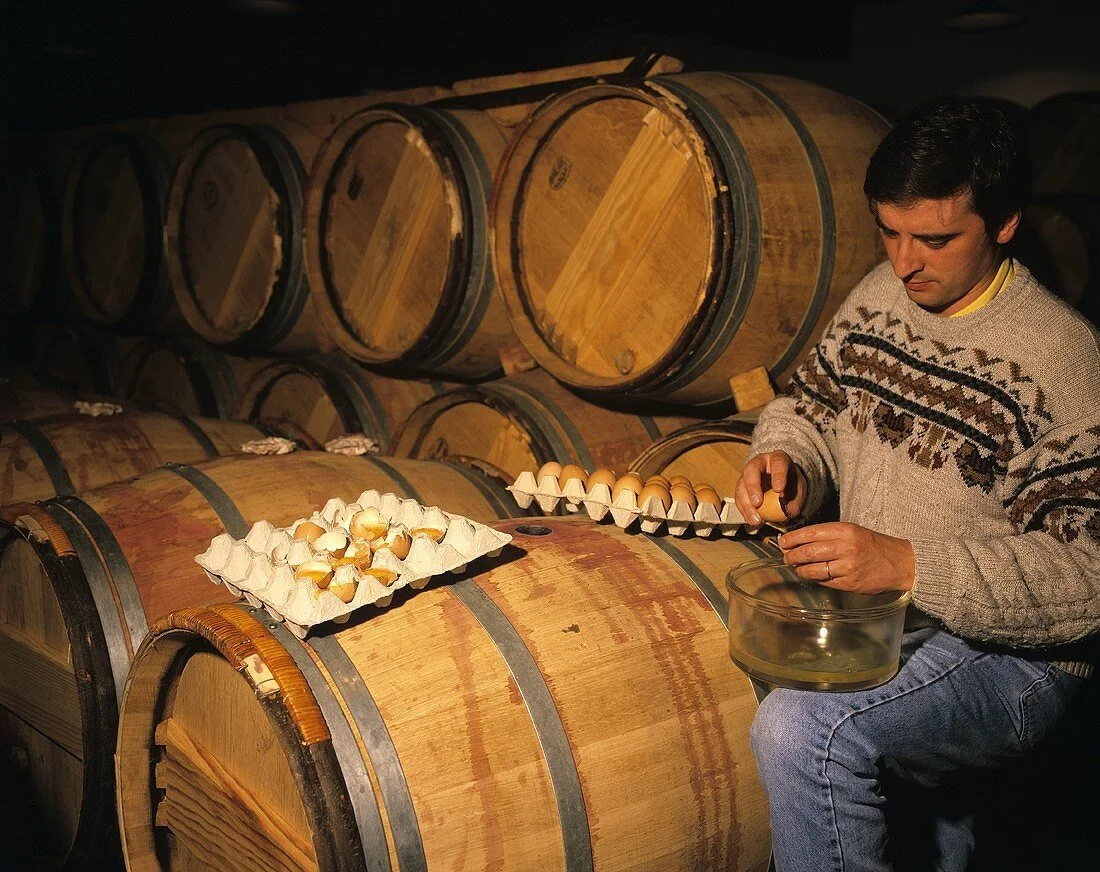
Egg whites: The famous and traditional method, particularly famous historically in Bordeaux and why we have a picture of a man cracking eggs like he’s a NYN member cracking puns. In Bordeaux they used to use the yolks to make the canelé cakes. It’s quite gentle and often used for polishing tannins in premium red wines, but also anti-vegan again.
PVPP: A synthetic fining agent used to remove oxidised phenolics and bitterness, particularly in whites and rosés
The Technical Details
Most fining relies on electrostatic charge interactions. Wine contains suspended colloids, tannins, proteins, polysaccharides, phenolic chains, and various unstable molecules carrying either positive or negative charges depending on pH and molecular structure.
Fining agents are selected partly based on their opposing charge characteristics.
Gelatin, for example, carries a positive charge under wine pH conditions and preferentially binds with negatively charged tannins and phenolic compounds. These complexes increase in molecular weight until gravity overcomes Brownian motion (the erratic jiggling of particles that keep them suspended in liquid), allowing sedimentation.
Inactive yeast cell walls work slightly differently. Their mannoproteins and glucan-rich structures adsorb reactive phenolics and volatile compounds through both ionic and hydrophobic interactions, while also influencing colloidal stability and oxygen buffering capacity. Adsorbing basically means they stick to each other and is slighly less strong than the chemical charge bonding.
The dosage matters enormously. Slight under-fining achieves little; slight over-fining can flatten texture, reduce aromatic persistence, strip colour, and shorten palate length. Which is why fining trials are done bench-scale first. We were amazed at the impact of the Gelatin with a very small dose.
Conclusion
For a wine travelling halfway around the world, some degree of stability matters, but tasting the three versions side by side was a reminder that every intervention comes with a trade-off and sometimes benefits. As with most winemaking decisions, fining isn't really about right or wrong; it's about deciding which compromises you're happiest to make when you don’t always the luxury of time. Fortunately our hand has not been forced in any direction for this vote!
Join Not Yet Named Wine Co. and become part of a wine club where you make the decisions.
You’ll follow each vintage and vote on every winemaking decision as well as the democratically designing a piece of art for the label.
6 BOTTLES NOW!
Receive your first six-bottle case as soon as you join. After that, you can use your credit to order wine whenever you want!
MIX YOUR CASE
Choose from the wines we have made before and build a case to suit you.
EXTRA SUBSCRIBER BENEFITS
Influence the additional wines we make for shops, bars and restaurants
See wines you helped create out in the wild
10% off additional wines, events and merchandise
Invitations to tastings, pick-up parties and school trips
Follow every vintage and track your votes through the app